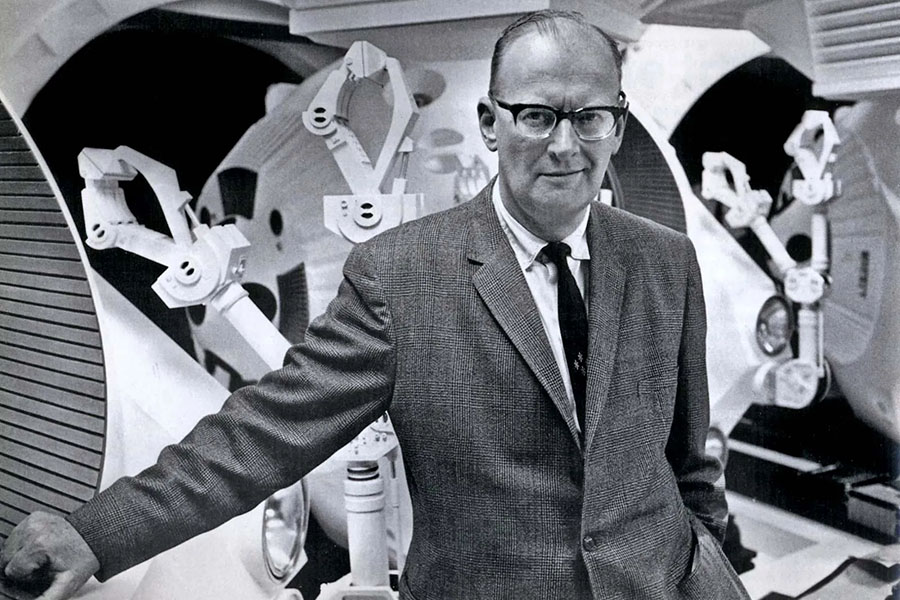
Arthur C. Clarke liked to say that the future was not something to be predicted, but something to be enabled.
That conviction ran through his life as a science fiction writer, a scientific thinker, and as a Fellow of the World Academy of Art and Science (WAAS). His relationship with the Academy was not incidental or ceremonial. It reflected a deep convergence between Clarke’s worldview and WAAS’s founding vision: that humanity’s survival and progress depend on aligning scientific power with ethical imagination and global responsibility.
Clarke was born in 1917 in rural England, a setting that gave him an early fascination with the night sky and a sense of wonder unencumbered by disciplinary boundaries. He never saw science and imagination as separate domains. As a radar specialist during World War II, he experienced firsthand how scientific advances could reshape the fate of nations. That experience left him with a lifelong awareness of science as a moral force—capable of extraordinary liberation, but also immense destruction if divorced from wisdom.
This tension became the engine of his writing. From Childhood’s End to 2001: A Space Odyssey, Clarke explored futures in which technological progress forced humanity to confront its own psychological, ethical, and spiritual limitations. His stories rarely celebrated technology for its own sake. Instead, they treated it as a mirror, reflecting the maturity—or immaturity—of the civilization wielding it. For Clarke, the real frontier was not outer space, but human consciousness.
That insight placed him naturally within the orbit of WAAS when it was founded in 1960. WAAS emerged in the shadow of the atomic age, created by scientists, artists, and thinkers who had witnessed how breakthroughs in physics had outpaced humanity’s capacity for governance, ethics, and foresight. Figures such as Albert Einstein, Robert Oppenheimer, and Joseph Rotblat understood that the old silos of knowledge were no longer viable. Clarke shared this conviction instinctively. His work had long argued that the future would demand integrated thinking—where science, ethics, culture, and imagination were in constant dialogue.
As a Fellow of WAAS, Clarke embodied the Academy’s commitment to transdisciplinary thought. He did not approach science fiction as escapism, but as a serious tool for civilizational reflection. In this sense, his novels functioned much like WAAS itself: as thought experiments designed to stretch human perception beyond short-term interests and national boundaries. Clarke’s famous assertion that “any sufficiently advanced technology is indistinguishable from magic” was not merely a clever aphorism. It was a warning. Without understanding and ethical grounding, advanced science risks becoming opaque, unaccountable, and dangerously mythic.
Clarke’s worldview also reinforced the Academy’s global perspective. Long before globalization became a common term, he rejected parochial nationalism. His decision to settle in Sri Lanka was not simply personal; it symbolized his belief that the future of humanity could not be narrated from a single cultural or geopolitical center. WAAS similarly positioned itself as a global institution, committed to planetary challenges rather than national agendas. Both Clarke and the Academy recognized that existential risks—nuclear weapons, environmental degradation, unchecked technological power—do not respect borders.
Perhaps most importantly, Clarke helped legitimize imagination as a necessary partner to science. WAAS was founded on the radical idea that artists and humanists must stand alongside scientists in shaping the future. Clarke’s career offered living proof of that premise. His fiction anticipated satellite communications, space stations, and artificial intelligence not because he was guessing wildly, but because he understood how human intention interacts with scientific possibility. He demonstrated that imagination, when disciplined by knowledge, can be a form of foresight.
This synthesis of realism and optimism deeply influenced the Academy’s tone. Clarke was not naïve about humanity’s flaws. Many of his stories end not in triumph, but in transformation—sometimes unsettling, sometimes ambiguous. Yet he remained fundamentally hopeful that intelligence, once sufficiently enlightened, could choose cooperation over catastrophe. WAAS adopted a similar posture: clear-eyed about risks, but committed to the belief that conscious, values-driven leadership can redirect the trajectory of civilization.
In retrospect, Clarke’s relationship with the World Academy of Art and Science feels inevitable. Both emerged from the same historical reckoning: that humanity had acquired godlike powers without godlike wisdom. Both sought to expand the time horizon of decision-making, urging society to think in centuries rather than quarters, in planetary terms rather than local advantage. And both insisted that the future is not a technical problem alone, but a human one.
Arthur C. Clarke once wrote that “the goal of the future is full unemployment, so we can play.” Beneath the wit lay a serious proposition: that the purpose of progress is not endless productivity, but the flowering of human potential. That idea—humane, expansive, and quietly radical—continues to echo in the vision of the World Academy of Art and Science. Through Clarke’s influence, the Academy inherited not just a science fiction writer, but a guide to imagining futures worthy of our intelligence.