Continuing to work on the shoulders of giants of science and humanism, let us remember our humanity and personal contribution to peace.
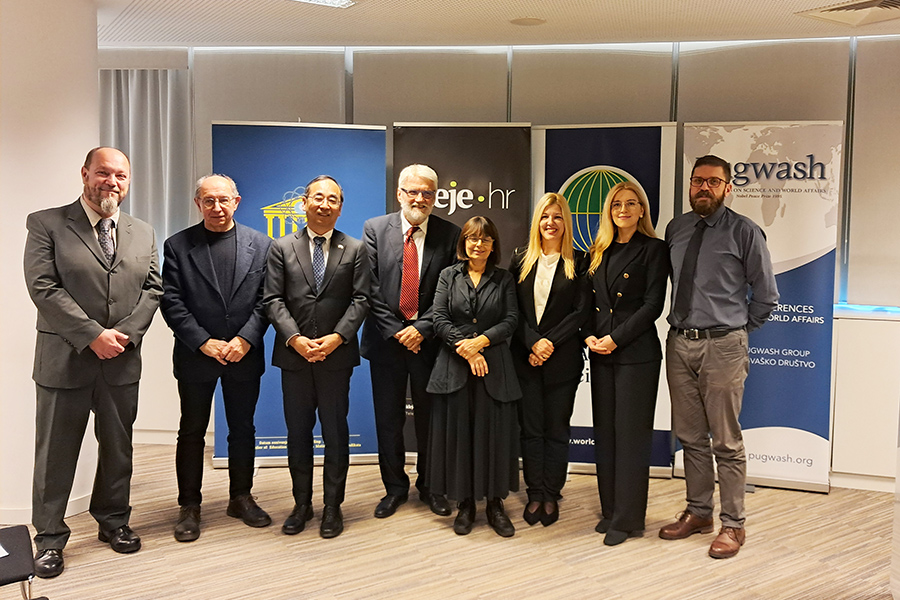
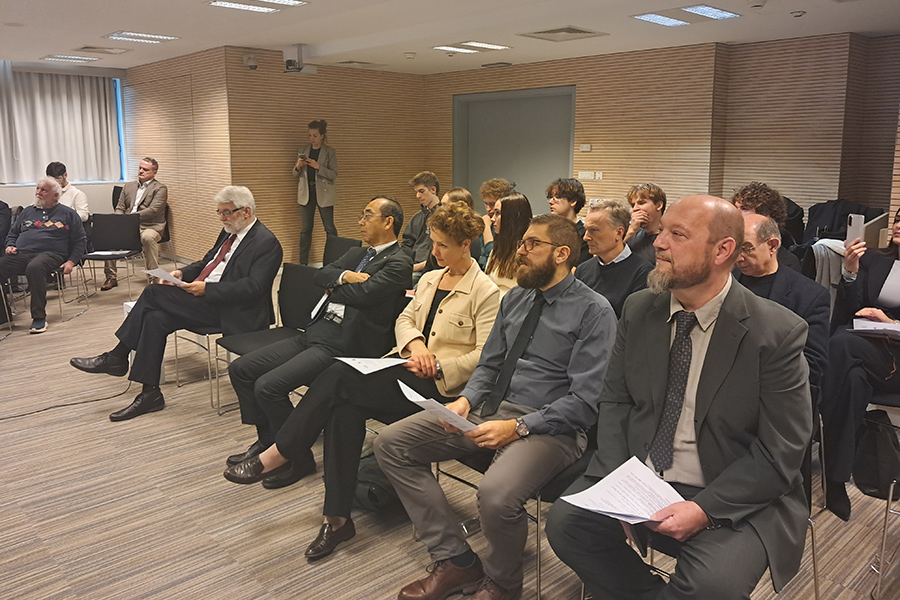
On 5 December 5 2025, at the premises of the Independent Union of Science and Higher Education in Zagreb, Croatia, a conference was held titled ‘The Role of Science in War and Peace: Dialogue, Respect and Dignity’ organized by the Croatian Pugwash and the World Academy of Art and Science, the Global Peace Offensive Center and the magazine Ideje.hr. The conference marked the 70th anniversary of the Russell-Einstein Manifesto, the 80th anniversary of the bombing of Hiroshima and Nagasaki, the 30th anniversary of the Nobel Peace Prize awarded to Sir Joseph Rotblat and the Pugwash Conference on Science and World Affairs, as well as the 110th anniversary of the birth of scientist and humanist Ivan Supek. The event was moderated by Rajka Rusan, a representative of Ideje.hr magazine, and was held under the high patronage of the President of the Republic of Croatia.
Zvonimir Šikić, President of Pugwash Croatia and World Academy of Art and Science Fellow, in his opening remarks emphasized the symbolic and moral significance of marking the anniversaries of the bombings of Hiroshima and Nagasaki, the Russell–Einstein Manifesto, and the awarding of the Nobel Peace Prize to Rotblat and Pugwash. He warned of the necessity of transforming historical memory into active responsibility in the face of contemporary global threats. He emphasized that the mission of Pugwash – opposing nuclear weapons and the misuse of science – is more important today than ever, and that the legacy of Einstein, Russell, Rotblat, and Supek’s work obliges us to wisdom and action.
In his presentation, academician Ivo Šlaus, Honorary President of the World Academy of Art and Science and Pugwash Croatia, warned of three key threats to humanity: artificial intelligence, nuclear weapons and climate change. Although the number of nuclear warheads has decreased, the risk of their use remains high due to geopolitical tensions. He emphasized that the climate crisis is a serious threat to the only habitat we have and that it requires urgent action. He called for a change in economic, political and personal paradigms so that we can face global challenges.
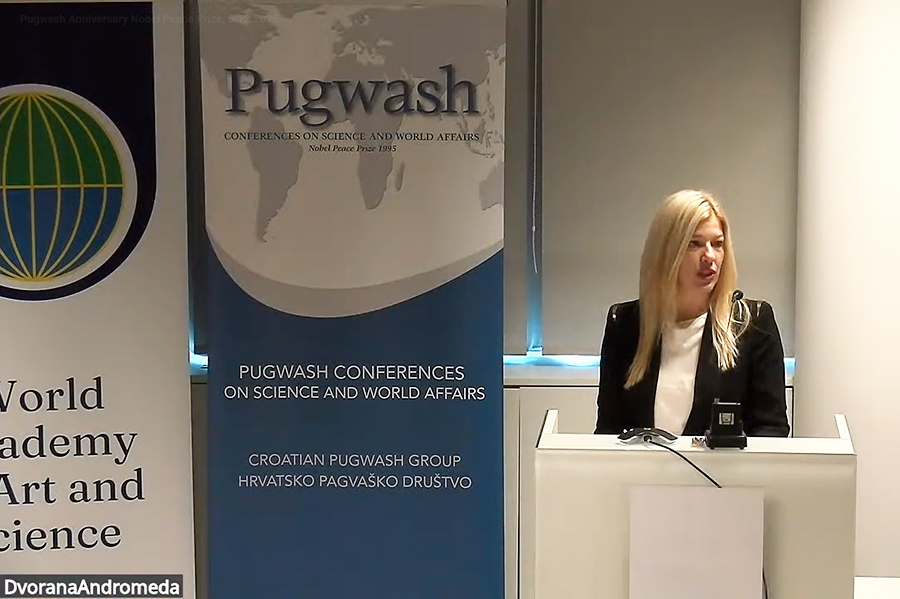
The Japanese ambassador to the Republic of Croatia, H. E. Mitsuhiro Wada presented Japan’s efforts in promoting nuclear disarmament and strengthening the Nuclear Non-Proliferation Treaty (NPT) regime. He emphasized the importance of simultaneously dealing with existing nuclear arsenals and promoting the philosophy of a ‘world without nuclear weapons’. He particularly highlighted the Hiroshima Action Plan, aimed at protecting from the accidental use of nuclear weapons, strengthening transparency, continuing to reduce the arsenal, and encouraging world leaders to visit Hiroshima and Nagasaki. He is convinced that nuclear disarmament can only be achieved if concrete measures and a long-term vision develop in parallel. He especially thanked the Croatian city of Biograd na Moru for actively remembering the victims of the nuclear bombing, through commemoration and the city’s membership in the world association “Mayors for Peace”, for which the mayor received a decoration from the Japanese emperor.
Students of the X. Gymnasium Ivan Supek presented the contribution of Ivan Supek Jr., about academician Ivan Supek and his role in the Pugwash movement. They recalled his role in establishing the Department for History, Philosophy and Sociology of Science, the Yugoslav branch of the Pugwash Conference, and the Institute for the Philosophy of Science and Peace. The contribution emphasized his involvement in stopping the development of the nuclear program in Yugoslavia and his many years of international activity. They also highlighted his temporary disillusionment with the movement in the late 1960s, but also his renewed engagement in the 1990s, when he strongly warned the international public about the JNA’s aggression in Croatia.
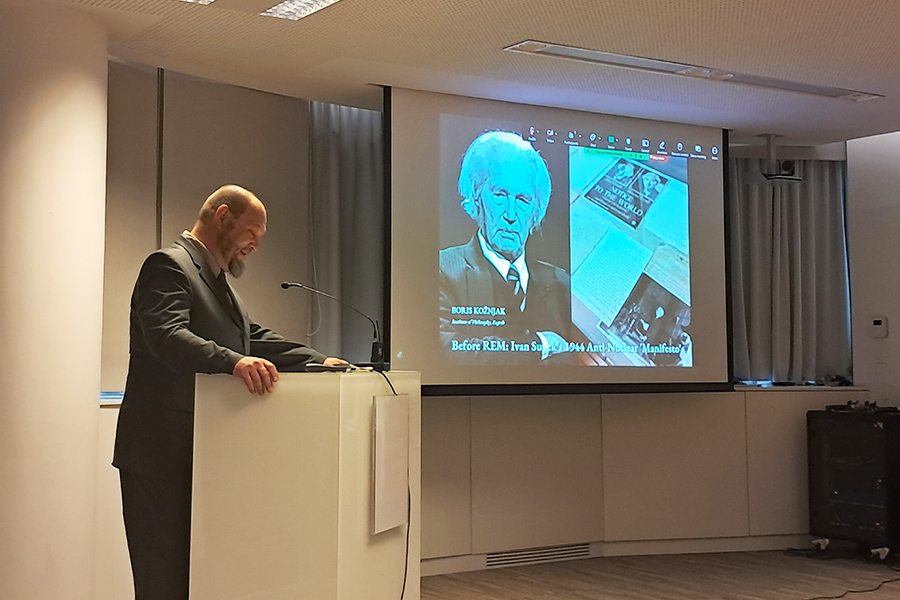
Boris Kožnjak from the Institute of Philosophy in Zagreb presented Ivan Supek’s anti-nuclear manifesto from 1944, in which Supek already warned about the dangers of nuclear energy and called for the creation of brotherhood and freedom among nations. He emphasized Supek’s exceptionally early recognition of the need for global disarmament and his ability to anticipate key themes of the later Russell-Einstein manifesto. He recalled Supek’s passionate and consistent fight against nuclear weapons and his criticism of the ideological and political misuse of science.
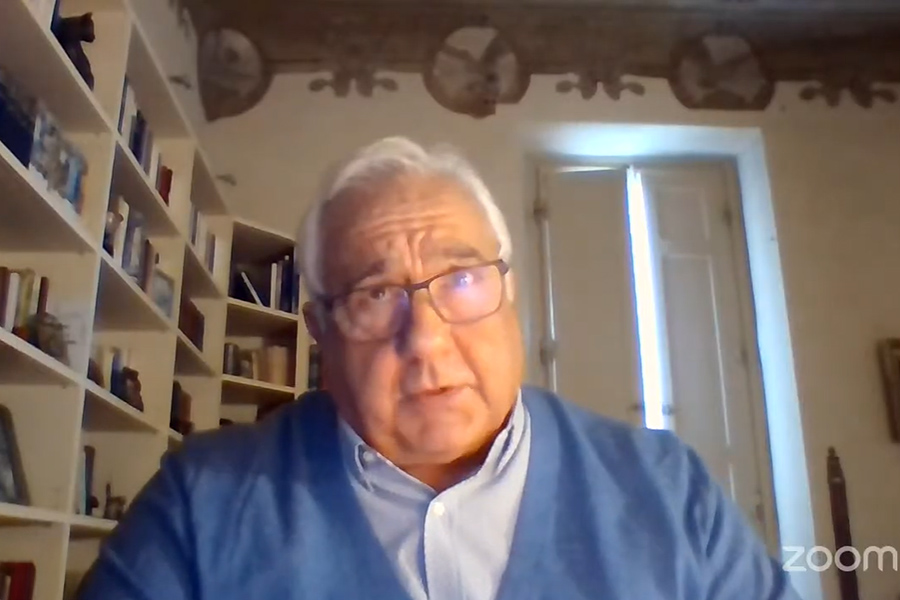
The Vice-President of the Croatian Nuclear Society Mario Matijević analyzed the role of nuclear energy as both a threat and a potential solution to climate change. He emphasized the advantages of nuclear energy, including emission reduction and technological development, but also risks such as proliferation and the need for rigorous safety mechanisms. He emphasized the importance of addressing the security and political factors that encourage nuclear armament in order to create the preconditions for the eventual abolition of nuclear weapons.
Vice President of the World Academy of Art and Science and President of the Global Peace Offensive Center Donato Kiniger-Passigli argued about the Russell-Einstein Manifesto and its value today. He emphasized that in a world where the international security system is frozen with immanent existential threats, military means do not help finding solutions. He warned of growing tensions, polarization and violence and emphasized the need for a bottom-up approach. Then he presented the goals and objectives of the Global Peace Offensive, and its approach to peace based on dialogue, relationship building and local initiatives, as an initiative with long term perspective and immediate action. He explained the methodology of ‘gradual reduction of tension’, aimed at problem solving and partnership between diverse actors, including scientists and civil society, with the aim of better understanding conflicts and finding adequate solutions. He mentioned also the Human Security for All Campaign of the World Academy of Art and Science. He reminded that along with science which represents knowledge, we must not forget art, which represents experience and internal knowledge, and can help us in peace activities and achieving peace in the world.
Ambassador Božo Kovačević addressed the preconditions for achieving peace in the current armed conflicts, namely the de-escalation of the conflict in Ukraine so that it does not turn into a world war. He stated that the lack of diplomatic activities between the West and Russia is one of the reasons for the weakening of the nuclear deterrence system, but also for achieving peace in general. He compared the balance of power between the West and Russia and the West and the Soviet Union during the Cold War, and stated that at that time, despite the different balance of power, diplomacy was not abandoned. He emphasized the need for renewed and intensive diplomatic efforts and pointed out that peace agreements must be in line with the UN Charter and accepted by all five permanent members of the Security Council.
Secretary General of the Pugwash Conferences on Science and World Affairs Karen Hallberg presented the key conclusions from the 63rd Pugwash Conference held in Hiroshima in November 2025, which focused on nuclear disarmament and the importance of dialogue between opposing parties. She emphasized the Hiroshima Declaration’s call to replace confrontation with dialogue, the need to renew American-Russian engagement in arms control, and the importance of strengthening the concepts of joint and cooperative security. She also emphasized the responsibility of the scientific community to guide politicians with scientific knowledge, rationality and ethical principles, especially in the context of new destabilizing technologies. She reminded of the permanent relevance of the message: “Remember your humanity and forget the rest.”
The chair of Young Pugwash Croatia Dalia Alić reflected on the Pugwash conference in Hiroshima from the perspective of young professionals and emphasized the importance of involving young professionals in discussions about international security. She invited students, young people up to the age of 35, who are interested in the topics of peace, disarmament and security to join this branch.
Academician Vlatko Silobrčić referred to a kind of war against science, asserting that science loses significantly in the battle with certain interest groups, and that the public is deprived of numerous results of scientific research. He invited the audience to read the book ‘The War on Science’ by editor Lawrence M. Krauss, in which freedom of speech, freedom of research and the scientific process as such are problematized.
In conclusion, the Vice-President of Pugwash Croatia Ana Jerković, World Academy of Art and Science Associate Fellow, in her closing remarks emphasized how dialogue, respect and dignity – in science and in everyday life – are key values for building peace. She emphasized the need to recognize our common humanity and the real and underlying motives of conflict. She also reminded of our responsibility to remember the victims of the past and, by learning from historical mistakes, to work towards creating a better and safer future. She called on everyone to personally contribute to peace in their community, guided by constructive thoughts, pure intentions and a spirit of understanding and humanism.