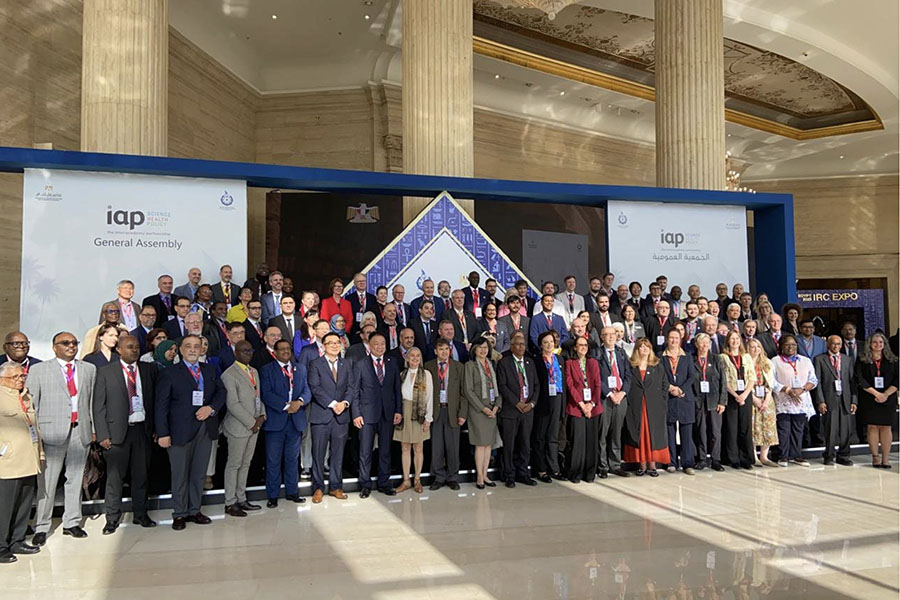
On 11 December 2025, the Inter-Parliamentary Union (IPU), in partnership with SCRAP Weapons, convened the webinar Parliaments and the Next Generation: A Shared Agenda for Disarmament. The event brought together parliamentarians, young leaders, academics and civil-society experts to examine how evolving security risks, from nuclear weapons to emerging technologies, can be addressed through more people-centered and forward-looking approaches.
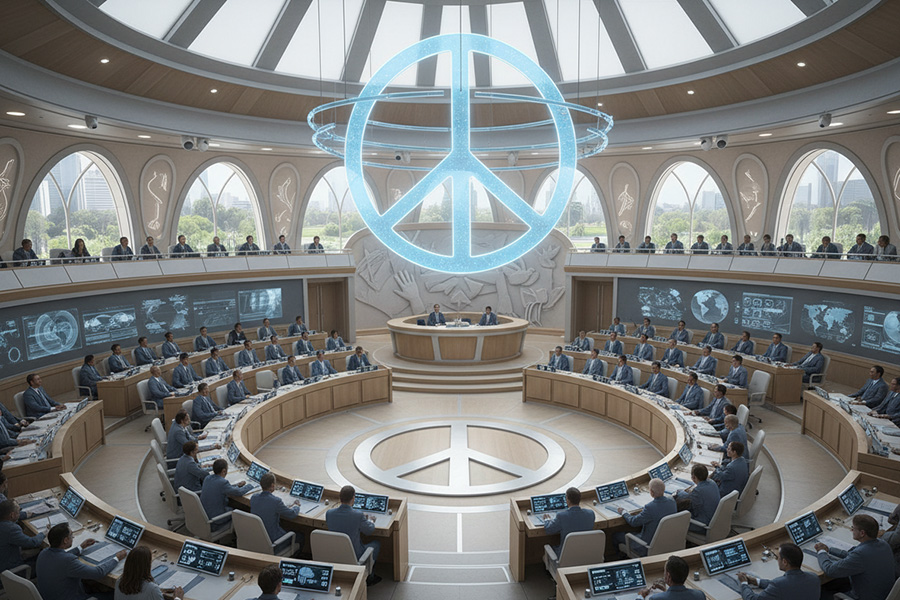
A central thread running through the discussion was the idea of a Global Peace Offensive. An idea to shift away from security models based primarily on deterrence and fear, toward approaches grounded in human security, common security, trust and shared responsibility.
In his intervention, Jonathan Granoff, president of the Global Security Institute, Trustee and a Fellow of the World Academy of Art and Science, framed the urgency of this shift by confronting participants with the realities of nuclear risk. He recalled the scale of existing arsenals, the history of near-misses caused by human and technical error, and the fragility of systems that depend on speed and individual judgment. Reflecting on this reliance on chance, he noted that “every day, we are living with good luck, and that’s not adequate policy,” arguing that security must be rethought through a human and common security lens. In this context, he pointed to initiatives such as The Global Peace Offensive, promoted by The World Academy of Art and Science, as a way of reframing security debates around shared vulnerability and responsibility.
Building directly on this framing, Emma Slažanská, junior researcher for The Global Peace Offensive/WAAS, carried the Peace Offensive logic into practical terrain relevant for disarmament and parliamentary action. She explained that the Global Peace Offensive begins from a simple recognition: “If we rely solely on top-level politics to resolve conflicts, we may be waiting for a very long time.” Instead, the initiative focuses on what can be influenced immediately, that being trust-building, local relationships, symbolic gestures, and the creation of spaces where dialogue can re-emerge. Emma also outlined the GPO’s diagnostic approach, which seeks not only to identify sources of tension, but to recognize what is already working within conflict systems: where cooperation persists, who continues to speak across divides, and which small “pivot points” could be strengthened. Linking this directly to the webinar’s theme, she stressed that disarmament is not only a technical process, but also a confidence-building exercise that supports a broader shift toward shared security.
The responses reinforced the Peace Offensive logic. Alyn Ware (Parliamentarians for Nuclear Non-proliferation and Disarmament) emphasized the role of parliamentarians, particularly younger ones, in moving beyond false binaries between deterrence and disarmament, and highlighted Assuring our Common Future[AW1] and Human security and common security to build peace[AW2] , two resources for parliamentarians on this issue produced by IPU, PNND and the International Peace Bureau. Meanwhile, Jonathan Granoff pointed to historical examples such as middle-power initiatives and nuclear-weapon-free zones, where trust-building steps reshaped political dynamics and prepared the ground for more ambitious agreements.
Overall, the exchange illustrated how the Peace Offensive can operate within parliamentary and disarmament spaces: by connecting hard security realities to human-centered analysis, and by showing how small, deliberate actions can help change the conditions in which peace and disarmament become possible.
[AW1]The link is https://disarmamenthandbook.org/
[AW2]The link is https://www.ipu.org/resources/publications/toolkits/2024-09/human-security-and-common-security-build-peace